
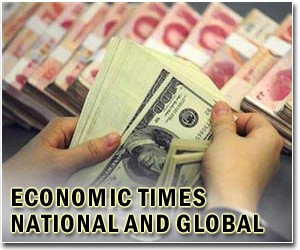
China raised its US debt holdings in August as global appetite surged for long-term Treasury bonds seen as a safe haven amid economic uncertainty, official data showed Monday.
China, excluding Hong Kong, remained by far the biggest holder of Treasury bonds and notes: 868.4 billion dollars' worth, reflecting an increase of 21.7 billion dollars from July, the Treasury Department reported.
Overall, net foreign purchases of US securities rose to 128.7 billion dollars in August, taking into account US residents' purchase of 7.9 billion dollars' worth.
The adjusted total was estimated at 111.8 billion dollars, two and a half times more than the July level, according to the monthly Treasury International Capital (TIC) data.
Purchases by foreign private and public investors surged to 136.6 billion dollars.
"In August, foreign investors were hungry, very hungry, for US Treasury bonds and notes. As a result, net private and public purchases of US Treasuries reached their third highest level on record, at 136.6 billion dollars," said Gregory Daco, US senior economist at IHS Global Insight.
"As we have seen over the last months, in times of great uncertainty over the global recovery investors continue to view US securities as a safe-haven refuge," he added.
Japan continued to be the second-largest holder of US debt, increasing its investment by 15.6 billion dollars, to 836.6 billion dollars.
Britain, in third place, pumped in a hefty 74.1 billion dollars, raising its US debt holdings to 448.4 billion dollars.
earlier related report
China aims for 'relatively fast' growth through 2015
Beijing (AFP) Oct 18, 2010 –
China, the world's second-largest economy, aims to maintain "stable and relatively fast" growth over the next five years, the ruling Communist Party said Monday at the close of its key annual meeting.
The country hopes to achieve a "major breakthrough in economic restructuring" as policymakers maintain measures aimed at boosting domestic demand, the official Xinhua news agency said.
Beijing has pledged to restructure the booming economy — which overtook that of Japan in the second quarter — to make it less reliant on exports and investment and, instead, make domestic consumption a bigger driver of growth.
"China will further boost people's incomes, enhance social construction and deepen reform and opening up," the party said in a statement issued at the end of the meeting by Xinhua.
The next five years will be a "critical stage for China to build a moderately prosperous society", the statement said, underlining concerns among top leaders about the yawning wealth gap between the country's rich and poor.
Improving basic public services would be "a key task", it added, noting that leaders had called for higher incomes, a stronger social security system and faster reform and development of the healthcare system.
"Building a comprehensive and sustainable (basic) service system that works in line with China's overall situation would help improve people's lives," the report said.
The end of the party plenum comes as China prepares to release key data on Thursday that is expected to show the economy continued to slow in the third quarter, as Beijing stepped up efforts to rein in property prices and curb bank lending.
After growing a blistering 11.9 percent in the first three months of 2010, growth slowed to 10.3 percent in the second quarter and most economists expect to see growth in the high single-digits in the third quarter.
Policymakers have introduced a range of measures this year aimed at cooling the red-hot real estate sector amid fears of a damaging bubble that could derail the economy and lead to social instability.
Despite these efforts, property prices rose in September from the previous month and new loans were higher last month compared with August, official data released last week showed.
China also vowed Monday to "actively participate" in global economic governance and regional cooperation, the party statement said.
"China will pursue a mutually beneficial strategy of opening up, further open up to the outside world and optimise its foreign trade structure," the statement said.
The leadership also announced plans to develop "new strategic industries" including alternative energy, biotechnology, high-end equipment manufacturing and environmental protection, it said.
The value-added output from these sectors would account for eight percent of the country's gross domestic product by 2015 and 15 percent by 2020, it said.
Share This Article With Planet Earth
