
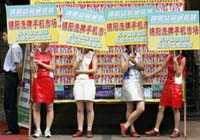
China announced Tuesday a massive expansion of subsidies for people who buy new cars and home appliances this year, state media said, in the government's latest bid to lift the crisis-battered economy.
The State Council, or cabinet, decided to increase the money available to subsidise car replacements to five billion yuan (733 million dollars) from one billion yuan when the programme was announced last month, the Xinhua news agency said.
China started to subsidise car replacements in 2003 and increased the fund to 600 million yuan last year, previous Chinese media reports said.
The government would also earmark two billion yuan this year to subsidise consumers who sell their home appliances for new ones, Xinhua said.
A trial programme would be launched first in four provinces and five cities including Beijing and Shanghai to subsidise the replacement of TV sets, refrigerators and three other types of home appliances, it said.
"In order to further boost domestic demand… it is necessary to implement policies to encourage auto and home appliance replacements," the report said, quoting a statement issued at the end of the meeting which Premier Wen Jiabao presided over.
"It will not only help expand domestic consumption but also improve energy and resources efficiency and cut pollution," it said.
The new incentive is the latest in a series of government measures to encourage Chinese consumers to spend in the face of slumping exports as foreign demand weakened due to the financial crisis.
Previously China introduced policies to subsidise farmers' purchases of home appliances and small cars.
China lets HSBC, BEA issue yuan bonds in Hong Kong: report
China has given the green light for Bank of East Asia and HSBC to issue yuan bonds in Hong Kong, state media said Tuesday, the first time foreign-invested lenders have been allowed to sell such debt.
It would also give Beijing the opportunity to make the currency more prevalent as the government looks to expand its influence.
The Chinese arms of London-based HSBC and Hong Kong's BEA received the permission from the State Council, or cabinet, according to the Financial News, which is run by the central bank.
The announcement came amid growing indications that China wishes to create the conditions for a more powerful yuan on the global scene, reflected in a series of swap agreements with foreign governments.
The Chinese central bank governor earlier this year also created waves by suggesting in an essay that a replacement of the US dollar as the world's reserve currency was a possibility.
The bonds will give the banks a broader range of options when it comes to accessing yuan capital and support financial market development in the city, the report cited an unnamed central bank official as saying.
It is the first time foreign-invested commercial banks have won approval to sell yuan-denominated bonds, according to May Yan, an analyst with Nomura International in Hong Kong.
"For the Chinese government, there may be some considerations such as (the ability) to expand the use of the yuan outside China," she told AFP.
Meanwhile, "yuan funding is quite important to foreign-invested banks, whose ability to absorb yuan deposits is constrained due to their limited (number of) outlets on the mainland," she said.
Previously only the Asian Development Bank and International Finance Corporation have been allowed to sell yuan bonds, and only in China.
The two development organisations issued a total of 2.1 billion yuan (308 dollars) in debt in the Chinese interbank market in 2005.
Bank of China and four other Chinese lenders have also issued yuan-denominated bonds in Hong Kong since 2007, the Financial News said.
Share This Article With Planet Earth
