
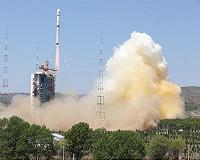
China launched two remote-sensing micro-nano satellites on a Long March-4B rocket from Jiuquan Satellite Launch Center in northwest China's Gobi Desert Thursday.
The OVS-1A and the OVS-1B, the first two satellites of Zhuhai-I remote-sensing micro-nano satellite constellation, are expected to improve the monitoring of geographical, environmental, and geological changes across the country, according to Beijing Institute of Space Science and Technology Information.
Compared with previous remote-sensing satellites, the OVS-1A and the OVS-1B are video satellites, featuring the function of conducting fast "gaze" observation. Its imaging scope covers more than 85 percent of global population.
The launch of the Zhuhai-I satellite constellation, composed of video micro-nano satellites, hyperspectral satellites and radar satellites, will be completed within the next two to three years.
China's space station to help maintain co-orbital telescope
China will develop and launch a two-meter-caliber space telescope, which will share the same orbit with the country's future space station, said Yang Liwei, deputy director of China Manned Space Agency.
The telescope will dock with the co-orbital space station for refueling as well as maintenance and exchange, Yang revealed at the ongoing Global Space Exploration Conference (GLEX 2017) whi … read more
