
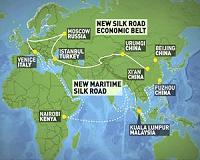
China touted on Sunday its new Silk Road as "a project of the century" at a summit highlighting its growing leadership on globalisation, but a North Korean missile test intruded on the meeting.
President Xi Jinping greeted leaders from 29 nations for the two-day summit in Beijing after US and South Korean military officials confirmed that Pyongyang had launched a ballistic missile.
Delegations from North Korea and the United States attended the forum, though not their leaders. Few Western heads of government made the trip.
The summit is showcasing Xi's cherished One Belt, One Road initiative, a revival of the ancient Silk Road trading routes that could cement China's growing global clout on trade and geopolitics.
"This is indeed a gathering of great minds," Xi said, addressing leaders including Russian President Vladimir Putin and Turkish counterpart Recep Tayyip Erdogan.
Xi pledged to pump an extra $124 billion in funds into the initiative, calling it "a project of the century" in a "world fraught with challenges".
The Chinese-bankrolled project seeks to link the country with Africa, Asia and Europe through an enormous network of ports, railways, roads and industrial parks.
The initiative spans some 65 countries representing 60 percent of the world population and around a third of global gross domestic product. The China Development Bank has earmarked $890 billion for some 900 projects.
The project is seen as a practical solution to relieve China's industrial overcapacity. But it could also serve Beijing's geopolitical ambitions as Washington retreats into "America First" policies.
While Xi did not mention North Korea during his speech to the delegates, it was discussed during a bilateral meeting with Putin.
"Both parties expressed their concern over the escalation of tensions" on the Korean peninsula, Kremlin spokesman Dmitry Peskov told reporters.
The Chinese foreign ministry said in a statement it opposed such missile tests and it called for restraint from all parties.
The delegates from both Koreas held a brief meeting at the summit, according to South Korea's Yonhap news agency.
"We strongly condemned North Korea's launch of the missile," said Park Byeong-Seug, who leads Seoul's delegation, according to Yonhap.
North Korea relies heavily on trade with China for its economic survival, and US President Donald Trump has urged Xi to use that leverage to put pressure on Pyongyang.
The White House called on all nations to impose "far stronger sanctions" following the latest test, which came days after South Korea elected a new president.
Sunday's missile launch "is absolutely an embarrassment to Beijing but it also shouldn't be overstated", Christopher Balding, economics professor at Peking University, told AFP.
"This will not overshadow (the summit) in an enormous way but it will absolutely continue to raise US frustrations with Beijing," he said, adding that Washington was "frustrated" that North Korea was also invited to the summit.
– Respecting sovereignty –
Xi focused on his initiative, boasting that it represented a "road for peace", but he cautioned "all countries should respect each others' sovereignty… and territorial integrity".
He warned that "isolation results in backwardness".
The new financing that he promised on Sunday includes 100 billion yuan ($14.5 billion) for the Silk Road Fund and lending schemes worth 380 billion yuan. He also urged financial institutions to contribute 100 billion yuan.
Praising Xi's initiative, Putin warned that "protectionism is becoming the norm".
"The ideas of openness, trade freedom are rejected more and more, very often by those who were their supporters not so long ago," Putin said.
Erdogan said Belt and Road was "going to be the kind of initiative that will put an end to terrorism".
– Indian concerns –
Some Belt and Road projects are raising concerns in certain countries.
India has voiced displeasure at the China-Pakistan Economic Corridor, a Belt and Road project aimed at linking northwestern China to the Arabian Sea.
The route cuts through Gilgit and Baltistan in Pakistan-administered Kashmir, disputed territory that India claims is illegally occupied.
Human Rights Watch raised fears on Saturday about the treatment of people along the new Silk Road route in Central Asian nations with poor track records in infrastructure projects.
India to boycott China summit amid Kashmir concerns
New Delhi (AFP) May 13, 2017 –
India signalled it will boycott a summit in Beijing on Sunday on boosting China's trade links to the rest of the world, setting off a new dispute between the neighbours.
The two-day summit is expected to be attended by Russia's President Vladimir Putin, Turkey's President Recep Tayyip Erdogan and 26 other leaders.
Without announcing a formal boycott, an Indian foreign ministry spokesman highlighted concerns about China's so-called One Belt, One Road (OBOR) initiative, a massive undertaking to link the country with Africa, Asia and Europe through a network of ports, railways, roads and industrial zones.
The spokesman also reaffirmed India's opposition to a Chinese-Pakistani economic corridor that runs through disputed Kashmir.
"Guided by our principled position in the matter, we have been urging China to engage in a meaningful dialogue on its connectivity initiative," said foreign ministry spokesman Gopal Baglay in a strongly worded statement released late Saturday.
"We are awaiting a positive response from the Chinese side," Baglay added.
"Regarding the so-called 'China-Pakistan Economic Corridor', which is being projected as the flagship project of the… OBOR, the international community is well aware of India's position.
"No country can accept a project that ignores its core concerns on sovereignty and territorial integrity," he said.
The China-Pakistan Economic Corridor passes through Gilgit and Baltistan in Pakistan Kashmir, which is claimed by India. The two sides have been at loggerheads over Kashmir since their division in 1947.
India's is also concerned because the 3,000 kilometre (1,850 mile) corridor ends in the strategic Pakistani port of Gwadar. India fears the port could become a Chinese naval base facing its navy in Mumbai.
India have had a series of niggles over the past year.
China has opposed India's entry into the Nuclear Suppliers Group (NSG), the club of countries sensitive nuclear technology, and UN action against a Pakistan-based militant leader, Masood Azhar.
China in turn protested after India last month let Tibetan spiritual leader the Dalai Lama visit Arunachal Pradesh, which Beijing claims.
The foreign ministry spokesman said India had been "formally" invited to the Beijing summit.
But he said India believes that "connectivity initiatives must be based on universally recognised international norms, good governance, rule of law, openness, transparency and equality."
There have to be "principles of financial responsibility to avoid projects that would create unsustainable debt burden for communities".
India insists that "connectivity projects must be pursued in a manner that respects sovereignty and territorial integrity," the spokesman said.
Chinese officials had earlier said they expected India to send an official delegation to the summit.
Nepal signs up to China's new Silk Road plan
Nepal on Friday signed up to China's new Silk Road drive, a massive infrastructure project spanning some 65 countries at the centre of the Asian giant's push to expand its global influence.
The long discussed deal between impoverished Nepal and its much bigger neighbour comes just days before China hosts a summit for 28 leaders near Beijing, showcasing the ambitious plan.
The One Belt, … read more
