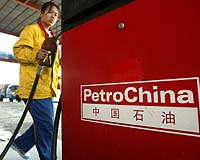
China should introduce a fuel tax and set up an energy-saving fund to help it reduce its wasteful consumption of oil, an official said Monday in the People's Daily, the Communist Party mouthpiece. "Imposing a fuel tax is designed to lead to rational oil consumption by increasing the cost of consumption in a gradual way," said Gao Shixian, head of research at the National Development and Reform Commission's energy center.
China is the second-largest oil importer in the world after the United States and its need for fuel resources has jumped sharply as its economy booms with growth of 10.9 percent in the first half of the year.
Demand is expected to average 7.03 million barrels per day in 2006, 7.42 million bpd in 2007 and 7.8 million bpd in 2008, the International Energy Agency said in a recent report.
Meanwhile, to ease the impact of oil price fluctuations on consumers, Gao suggested the fuel tax rate should be adjusted in line with international oil prices.
Setting up an energy saving fund would help boost energy efficiency, Gao said, without explaining how.
Gao said China must also establish a new oil product pricing mechanism that reflects true market supply and demand.
China caps oil costs at home in order to stifle inflation, with prices based on the previous month's oil product prices in New York, Singapore and Rotterdam plus transportation costs and customs duties.
Last year, major fuel shortages emerged in the southern business hub of Guangdong after Chinese refiners, faced with certain losses, held back supply at a time when they had to pay then-record oil prices.
Chinese refiners have been losing billions of dollars since oil prices broke through 60 dollars a barrel because state regulations limit the prices they can charge customers.
Beijing has been struggling over how to overhaul its rigid and distorting oil pricing system but is concerned that a completely free market could lead to social instability if poorer people suffered as a result of high prices.
Source: Agence France-Presse