
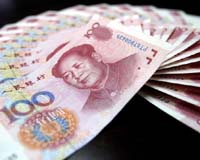
China's trade surplus hit a monthly record of 18.8 billion dollars in August, state media said Monday, just days before a key international meeting where the country's currency and trade practices could be in focus. Based on previously released government statistics, the figure, which was made public by the Xinhua news agency, was up nearly 80 percent from a trade surplus last August of about 10.6 billion dollars.
"The numbers can be volatile month to month, but it was a strong number. There's no escaping that," said David Cohen, the Singapore-based director of Asian economic forecasting at Action Economic.
China's previous record was in July when a 14.6-billion-dollar surplus was recorded, up from 14.5 billion dollars in June, according to statistics published earlier.
Exports in the month soared 32.8 percent to 90.8 billion dollars from a year ago, with imports up 24.6 percent at 72 billion dollars, Xinhua said, citing customs statistics.
In the first eight months of the year, the accumulated surplus hit 94.7 billion dollars, Xinhua said.
That puts the nation well on the road to exceeding its 2005 trade surplus of 101.9 billion dollars, itself a record and triple the 2004 figure.
"This is consistent with the trend of the last few months that the surplus is rising, primarily due to strong exports," Morgan Stanley's Hong Kong-based China economist Andy Xie told AFP.
"The number may be a little bit of a one-off because 32.8 percent growth (in August exports) is not consistent with the previous month which was about 22.6 percent, so next month I expect the growth will slow down."
The spike in August exports, which was also seen in Taiwan and South Korea, could further mean that the US economy is not slowing to the degree that many economists believed, Xie said.
"In the end, Chinese exports come from US consumer spending. That's the bottom line and US consumers are spending," Xie said.
China's soaring trade surplus has been an engine of growth at home but a source of complaints abroad as US and European officials have argued it has been fueled by an undervalued Chinese currency.
China's economy skyrocketed 11.3 percent in the second quarter of the year, boosted mainly by exports and state-financed investment.
The trade data were released ahead of a key meeting of international finance ministers and central bankers in Singapore this week.
The gathering is likely to see renewed calls for China to step up the pace of currency reform and allow the yuan to appreciate.
"With China on stage in Singapore this week… people didn't need anything more to talk about China," said Cohen.
"It only intensifies the international pressure to allow the yuan to appreciate further."
Adding to that pressure are forex reserves that hit 954.5 billion dollars at end of July and which now, with the roaring exports of August, will creep even closer towards the symbolic trillion-dollar mark.
An editorial in the official China Daily however said that any large appreciation of the yuan was unlikely.
"Maintaining the stability of the exchange rate should be the focus of the macroeconomic coordination and regulation currently afoot," the editorial said.
"The exchange rate should enjoy some flexibility but there should be no sharp rise."
Source: Agence France-Presse
