
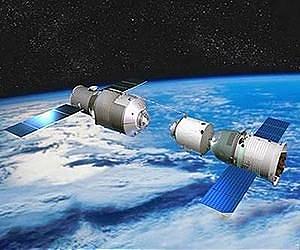
The unmanned space module Tiangong-1 that China plans to launch this year will be sent into space by a modified Long March II-F carrier rocket, an expert told Xinhua Thursday.
The 8.5-tonne Tiangong-1, or Heavenly Palace 1, is expected to be launched into space in the second half of this year to perform the nation's first space docking.
It will dock with the unmanned Shenzhou-8 spacecraft, which will be launched two month's after Tiangong-1.
"Both Tiangong-1 and Shenzhou-8 will be launched by a Long March II-F carrier rocket," said Liang Xiaohong, a senior executive of the China Academy of Launch Vehicle Technology, while attending the annual session of the National Committee of the Chinese People's Political Consultative Conference, the country's top political advisory body.
Researchers have made nearly 170 technological modifications, including 38 major ones, to the original Long March II-F model, Liang said.
The Long-March II-F rocket is known as the safest in China. Developed in 1992, the rocket has successfully sent seven spaceships – from Shenzhou-1 to Shenzhou-7 – into space.
Liang also said China would launch two other spacecraft in the coming two years, Shenzhou-9 and Shenzhou-10, both of which would dock with Tiangong-1.
Space experts have said the country will conduct more than 20 space missions this year.
Last year China conducted 15 space missions.
related report
China To Launch First Space Lab By 2016
A Chinese senior space technology expert said Thursday that China is expected to launch its first space laboratory before 2016.
"With the technological program ready, the lab's research and development are going smoothly," Qi Faren, former chief designer of Shenzhou spaceships, told Xinhua in an exclusive interview.
As the second phase of China's manned space program, the lab, likely to be named Tiangong-2, will gradually be developed into the core module or experiment module, said Qi.
China is to launch its first unmanned space module, Tiangong-1, or Heavenly Palace, in the second half of 2011, serving as a platform for spacecraft to rendezvous and dock – allowing for the building of the space station.
China will have its own space station before 2020, said Qi, a member of the 11th National Committee of the Chinese People's Political Consultative Conference, before the annual session of the country's top political advisory body, which is scheduled to open Thursday.
Source: Source: Xinhua
Share This Article With Planet Earth
