
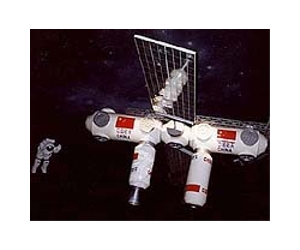
China has formally begun its manned space station program, aiming to complete construction of a "relatively large" manned space laboratory around 2020, said a spokesman for the national manned space program.
China was aiming to develop and launch the first part of a space laboratory before 2016, focusing on breakthroughs in living conditions for astronauts and research applications, the spokesman said.
The country would develop and launch a core cabin and a second laboratory module around 2020, which would be assembled in orbit around the earth into a manned space station, he said.
"Technologies needed to build and run the space station complex and long-term manned space flight in terrestrial space will be grasped," the spokesman said.
He said the project would build on the achievements of previous projects and continue to use the Shenzhou spacecraft and Long March F carrier rocket, and their launch and landing sites.
"After the construction of the space station, China's three-step manned space program will be complete," he said, adding this would enhance the country's technological progress, innovation, comprehensive power and the nation's prestige.
The three-step strategy involved first developing the Shenzhou spaceships, and then technologies needed for docking and extra-vehicular activities, currently underway, and finally construction of the space station.
China planned to launch two unmanned space modules, Tiangong-1 and Shenzhou-8, in 2011, which were expected to accomplish the country's first space docking and were regarded as an essential step toward building a space station.
Tiangong-1, or Heavenly Palace, would eventually be transformed into a manned space laboratory after experimental dockings with Shenzhou-8, Shenzhou-9 and Shenzhou-10 spacecraft, with the last two carrying two or three astronauts each.
earlier related report
NASA Administrator Statement On China Visit
Washington DC (SPX) Oct 28 – On October 16-21, NASA Administrator Charles Bolden led a small delegation to China. The following is a statement from the Administrator regarding his visit:
"On behalf of the NASA delegation that traveled to China, I want to express my appreciation to the China Manned Space Engineering Office, our hosts for my visit.
"Our delegation conducted a very comprehensive visit to Chinese human spaceflight related facilities including the Jiuquan Satellite Launch Center and conducted meetings with relevant senior officials in the Chinese government.
"I am pleased that NASA was able to meet its objectives for the visit, which included becoming acquainted with relevant Chinese space officials and institutions, better understanding Chinese human spaceflight programs and plans, and reaching a common understanding of the importance of transparency, reciprocity and mutual benefit as the underlying principles of any future interaction between our two nations in the area of human spaceflight.
"I also had an opportunity to meet with my counterpart at the China National Space Administration to review the ongoing efforts of Space and Earth Science working groups, established in 2007, to explore areas of mutual interest.
"Although my visit did not include consideration of any specific proposals for future cooperation, I believe that my delegation's visit to China increased mutual understanding on the issue of human spaceflight and space exploration, which can form the basis for further dialogue and cooperation in a manner that is consistent with the national interests of both of our countries."
Full text of the November 2009 U.S.-China Joint Statement
Share This Article With Planet Earth
