
Ten days after North Korea staked its claim as a nuclear power with its first atomic test, Chinese President Hu Jintao dispatched a senior envoy to Pyongyang to defuse the escalating global crisis. North Korea had defied its closest ally, most important source of aid and biggest trading partner by conducting the nuclear explosion just 200 kilometres (120 miles) from the two nations' border, and Hu clearly was not amused.
China rarely makes public its sensitive dealings with other nations, but on this occasion it looked keen to show it was making big efforts to rein in its troublesome communist neighbour.
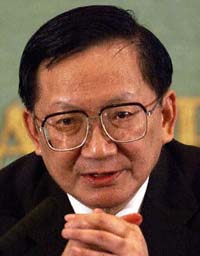
It announced that Tang Jiaxuan, a former foreign minister, had met Kim Jong-Il to make the first confirmed direct contact between a foreign official and the reclusive leader since North Korea conducted its October 9 atomic test.
"This is a very significant visit against the backdrop of major changes in the situation on the Korean peninsula," foreign ministry spokesman Liu Jianchao said at the time, adding Tang had delivered an "important" message.
The visit was part of a concerted campaign by China to rein in North Korea, the benefits of which could be seen in Tuesday's six-nation deal that saw Pyongyang agree to suspend its nuclear facilities, Chinese and Western analysts said.
"I think Tang Jiaxuan told North Korea not to go too far, that the international community was very concerned about the nuclear test and the situation was very serious," Huang Dahui, a director of research at the People's University Centre on Eastern Asia Studies in Beijing, told AFP.
John Feffer, a US-based Korea expert and global affairs director at the International Relations Centre, said Tang had also most likely warned Kim about the many drawbacks in conducting a second nuclear test.
Feffer said other pressure China placed on North Korea in a bid to encourage it to wind back its nuclear programme was a discreet reduction in oil supplies, some food aid and currency transactions.
However, he said China was always careful not to apply so much pressure that Kim's rule may have been jeopardised as, for many reasons, Beijing does not want regime-change in North Korea.
And while North Korea does listen to China, ultimately it acts for its own reasons and not at the behest of its "big brother", according to Feffer.
"North Korea will certainly do things that China asks it to do, if it fits in with its own strategies and goal," Feffer said.
Scott Bruce, a US-based operations director with the Nautilus Institute public policy think-tank, agreed and said a key part of China's campaign was to show North Korea that winding back its nuclear ambitions was in its own interests.
"China was always very clear in showing North Korea what they had to gain," Bruce said.
These benefits partly materialised in Tuesday's deal, which saw North Korea promised 50,000 tonnes of fuel oil for closing its key nuclear facilities in 60 days and one million tonnes for permanently disabling them.
For North Korea — one of the world's poorest countries — the second part of the deal was worth around 300 million dollars, according to Victor Shum, a Singapore-based oil analyst.
The United States also committed to holding direct talks on establishing diplomatic ties with North Korea, begin looking at removing it from its list of terrorist nations and quickly end a long-running dispute over financial sanctions.
Chief US negotiator Christopher Hill praised China on Tuesday for helping to broker the deal.
"We are so appreciative of the efforts of the Chinese," Hill said.
"The Chinese worked very hard to keep everybody on task and to really close the deal."
earlier related report
North Korea Nuclear Deal Echoes 1994 Agreement
Seoul (AFP) Feb 14 – The agreement reached Tuesday at six-party talks in Beijing, under which North Korea agreed to disable nuclear facilities in return for energy aid, has echoes of a 1994 deal between the United States and the communist state. The Agreed Framework signed in Geneva on October 21, 1994, ended a crisis over the North's nuclear programme which had come close to sparking a war the previous year.
It required Pyongyang to freeze and eventually dismantle its nuclear facilities in return for two proliferation-resistant light-water nuclear reactors, and shipments of heavy fuel oil.
The deal also stated that the two countries should move towards normalising political and economic relations.
Some four million tonnes of oil had been shipped to the North and the reactors had been part-completed by the time the deal fell apart in 2002.
In October that year Assistant Secretary of State James Kelly visited North Korea. Later that month the US claimed the North had admitted running a secret highly enriched uranium programme, in breach of the spirit of the 1994 accord.
Fuel shipments were suspended and the North in response removed seals and surveillance equipment from its nuclear facilities and expelled UN nuclear inspectors.
In January 2003 it announced its withdrawal from the Nuclear Nonproliferation Treaty.
Supporters of the Agreed Framework say it succeeded for eight years in freezing the North's processing of plutonium for atomic weapons.
This week's Beijing agreement "sounds like the Bush administration has put things back to where they were at the end of the Clinton administration — only now the North Koreans have tested a nuclear weapon and have enough plutonium for seven to 10 nuclear bombs," said Robert Einhorn, a top US weapons expert.
Source: Agence France-Presse
