
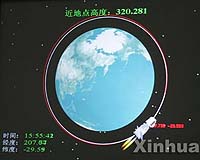
China's space capabilities, both civil and defence- oriented, are rapidly gaining ground on Russia and the United States, the world's most developed space programmes, Anatoly Perminov, head of Russia's Federal Space Agency, said Tuesday. "Today two countries – the US and Russia – maintain space programmes that cover all aspects from peaceful to defence purposes. China is approaching very close," Perminov said, the Itar-Tass news agency reported.
In wide-ranging remarks on Russia's space programme, Perimov also said the price to travel into the cosmos would rise for space tourists.
"Twenty million to 25 million (US) dollars is what they pay now," the space agency chief said. "Whether we want it or not, that price, naturally, will rise."
Perminov did not specify what the expected price increase would be, but said it was explained by the recent fall of the dollar.
Touching on Russia's answer to the US GPS navigation system or Europe's Galileo, Perimov said by the end of 2009 Russia expected a full slate of 24 satellites circling the earth, feeding private users geographical coordinates as part of the Glonass system.
"The global navigation system Glonass is actively developing … (President Vladimir Putin) personally tasked not only its development, but its launch. We hope by the end of 2007 there will be 18 satellites, and by the end of 2009, 24 satellites," Perimov said.
Russia has pledged in recent weeks to put 2 billion rubles (80 million dollars) toward Glonass, and three satellites are scheduled to enter orbit from Baikonur Cosmodrome, in northern Kazakhstan, on December 26.
Perimov added that 26 of Russia's 89 regions had already signed contracts for use of the system, and that talks were under way with the United States, European Union, India, Kazakhstan and Ukraine for cooperation in Glonass.
