
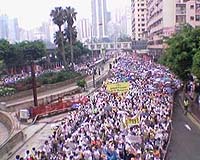
China Thursday urged "sober-minded discussion" on Hong Kong's political development, reacting to a call by the region's pro-democracy leader for the use of "people power" to obtain more freedom.
"We believe that all walks of life of Hong Kong society should proceed from the overall interest of prosperity and stability in Hong Kong," foreign ministry spokesman Qin Gang said.
"(They should) conduct sober-minded discussions to seek consensus so as to promote the development of Hong Kong's political system in a stable, solid and orderly manner," he said.
His remarks came a day after Hong Kong pro-democracy leader Martin Lee used a US visit to blame the territory's chief executive Donald Tsang "for not reflecting the strong aspirations of the people of Hong Kong to Beijing."
"The people of Hong Kong have no other option but to show solidarity by joining together by taking part in peaceful assembly to voice our aspirations, to let the Beijing leaders know we really want and deserve democracy," Lee told a public forum in Washington.
Lee was in the United States ahead of a planned mass democracy rally in Hong Kong on Sunday.
US Secretary of State Condoleezza Rice, during talks with Lee on Tuesday, emphasized "our conviction that the people of Hong Kong should determine the pace and scope of political reform in accordance with the Basic Law."
Rice told Lee: "We support democracy and universal suffrage in Hong Kong." But Qin insisted that the Hong Kong issue was a matter for China alone to deal with.
"Hong Kong affairs are China's internal affairs. We're opposed to any foreign intervention," Qin said.
"The Chinese government has all along paid attention to and vigorously supported Hong Kong's gradual political development in accordance with law and in line with the actual conditions."
When Britain handed sovereignty of Hong Kong back to China in 1997, the post-colonial constitution, or Basic Law, provided for the eventual full democratic election of the territory's leaders.
However, the timing of the provision was hotly debated and led to a political dispute between Hong Kong democrats and communist leaders in Beijing.
Beijing reinterpreted the provision in April 2004 and ruled out a swift transition to full elections by 2007, apparently fearing it could spark political instability in the rest of China.
