
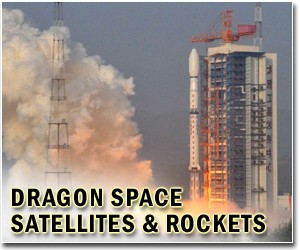
Last week, the 63rd International Astronautical Congress was held in Naples, Italy. One of the more interesting papers addresses the recent Chinese Chang'e-2 mission to the Earth-Sun L2 Lagrange point, located along the extended line of the two bodies, but lying in the shadow of the Earth.
Chang'e-2 was launched two years ago, on Oct 1st 2010. It primary mission was to maintain a lunar orbit for several months, which was successful.
That mission was completed by April 2011 and an additional mission to L2 was initiated in June 2011. Thus, Chang'e-2 escaped from its lunar orbit and made the transfer to the Lagrange point. Again, the Chinese spacecraft succeeded, this time to establish a Lissajous orbit in August of last year.
By way of explanation, Lagrange points are the five positions in an orbital configuration where a small object affected only by gravity can theoretically be part of a constant-shape pattern with two larger objects, in this case a space probe with respect to the Earth and Sun.
Lagrange points represent positions where the combined gravitational pull of two large bodies provides a balance to centripetal forces needed to create a force equilibrium in a constant pattern.
A Lissajous orbit is a quasi-periodic orbital trajectory that an object can naturally fly around a Lagrange point of a three-body system. Lissajous orbits include components in the plane of the primary bodies and perpendicular to it, and follow a Lissajous curve.
In reality, any orbit around a Lagrange point that lies along the line of the two primary bodies is dynamically unstable. This means that small departures from equilibrium grow over time. Thus, spacecraft that must maintain station keeping about such points require the use of propulsive systems.
China achieved two noteworthy milestones with Chang'e-2.
First, it is the first Chinese mission to a Lagrange point.
Second, it is the first time any probe escaped from a lunar orbit and traveled to the L2 point. It should also be noted that the technology for such missions has been around for decades, but had not been available to China until recently.
Nevertheless, this mission does demonstrate the fact that China is advancing its space capabilities rapidly and is at least on par with other advancing spacefaring nations.
Such progress is worth watching, as China's progress will surely influence future space mission planning of all spacefaring nations.
