
ISRO has agreed to carry two NASA research instruments aboard its Chandrayaan-1 spacecraft, the Indian lunar-orbiting mission planned for launch next year, The Hindu newspaper reported Sunday.
The agencies are expected to sign a memorandum of understanding on the matter when NASA Administrator Michael Griffin visits G Madhavan Nair, his Indian counterpart, on May 9.
Under the terms, NASA would provide two payload elements: a Miniature Synthetic Aperture Radar, or MSAR, and a Moon Mineralogy Mapper operating in 0.7-3.0 micrometer band.
Chandrayaan-1 also is expected to carry instruments from Bulgaria and ESA, along with its base research package, which is intended to study the lunar surface in detail.
The Indian instruments include an impactor that will help analyses of surface materials for future human landings, an X-ray spectrometer, a high-resolution laser-ranging instrument, a terrain mapping camera with 3-D imaging capability.
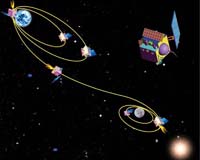
The spacecraft will be launched by India's Polar Satellite Launch Vehicle from the Satish Dhawan Space Center at Sriharikota. The mission profile calls for Chandrayaan-1 to orbit the lunar poles in a roughly circular orbit at an altitude of 200 kilometers (125 miles), and then drop to a 100 kilometer (62 mile) orbit. The designed mission lifetime is two years.
