
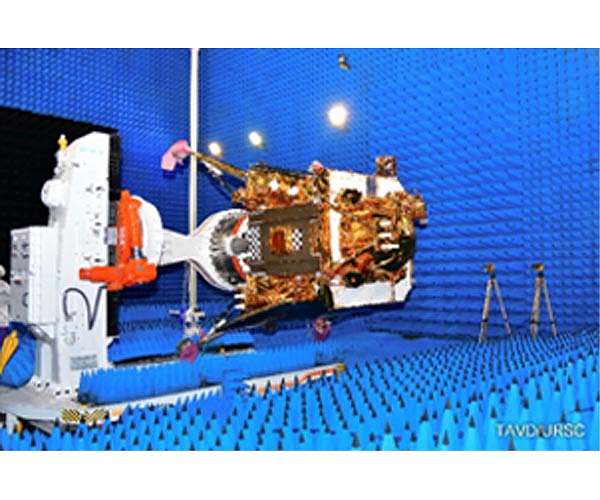
The Chandrayaan-3 lander has successfully passed its EMI/EMC test, which took place from January 31 to February 2, 2023, at the U R Rao Satellite Centre in Bengaluru.
This test is crucial for satellite missions as it ensures the satellite subsystems' functionality in the space environment and their compatibility with the expected electromagnetic levels. It is considered a significant milestone in the satellite's realization.
The Chandrayaan-3 interplanetary mission comprises three primary modules, namely the Propulsion module, Lander module, and Rover. Due to the mission's complexity, establishing radio-frequency (RF) communication links between the modules is essential.
During the Chandrayaan-3 lander EMI/EC test, Launcher compatibility, Antenna Polarization of all RF systems, Standalone auto-compatibility tests for orbital and powered descent mission phases, and Lander and Rover compatibility tests for post-landing mission phases were all verified. The systems performed satisfactorily.
The Chandrayaan program is a series of Indian lunar exploration missions that started with Chandrayaan-1 in 2008. The program's objective is to explore the Moon's surface and conduct scientific experiments. Chandrayaan-2 was launched in 2019, which included an orbiter, lander, and rover.
Although the lander Vikram failed to land successfully, the orbiter is still operational and conducting experiments. The successful EMI/EMC test for the Chandrayaan-3 lander is a positive step towards India's continued exploration of the Moon through the Chandrayaan program.
