
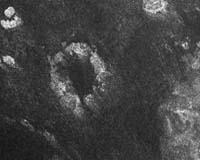
This image of Titan from the Cassini spacecraft's Synthetic Aperture Radar shows the southwestern area of a feature called Xanadu (at bottom right). The area is bright because it reflects the radio wavelengths used to make this radar images.
Cassini's instrument captured the image during its flyby of Saturn's giant moon on April 30.
Xanadu, one of the most prominent features on Titan that first was detected by ground-based observations, remains a mystery.
This radar image reveals details previously unseen, however, such as numerous curvy features that may indicate fluid flows. Linear dark streaks visible in radar-dark areas are dune fields, which have been seen in previous Cassini radar images.
Near the center of the image is a prominent circular feature named Guabonito, which is about 90 kilometers (56 miles) in diameter. It might be an impact crater or a cryovolcanic caldera.
If it is an impact structure, the absence of an ejecta blanket suggests the feature has been highly eroded, like some impact structures on Earth – or, it has been buried by the dune fields.
Other radar-bright areas (top left and top right) appear to be topographically high and might act as obstacles, diverting the dunes around them.
