
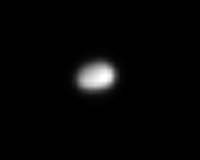
This magnified view shows tiny Polydeuces, a moon discovered by NASA's Cassini spacecraft last month, is a mere 3 kilometers (2 miles) across. Along with much larger Helene (32 kilometers, or 20 miles across), Polydeuces orbits Saturn at the same distance as large, icy Dione (1,126 kilometers, or 700 miles across).
Because this body was only recently discovered and is so small, scientists know precious little about it. Further observations by Cassini may yield additional insights about its nature and composition, said mission controllers at Jet Propulsion Laboratory.
Cassini took the image May 22 with its narrow-angle camera at a distance of approximately 73,000 kilometers (45,000 miles) from Polydeuces and at a Sun-Polydeuces-spacecraft, or phase, angle of 41 degrees.
Cassini obtained the image using a spectral filter sensitive to wavelengths of infrared light centered at 752 nanometers. Scale in the original image was 434 meters (1,423 feet) per pixel, but mission scientists magnified it by a factor of four and applied contrast enhancements to aid its visibility.
