
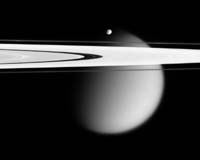
NASA's Cassini spacecraft captured this image of Saturn's small, battered moon Epimetheus; its giant, smog-enshrouded moon Titan, and its A and F rings stretching across the scene. The prominent dark region visible in the A ring is called the Encke Gap, in which the moon Pan and several narrow ringlets reside.
Moon-driven features that mark the A ring are easily seen to the left and right of the Encke Gap, which is 325 kilometers (200 miles) wide. Pan is 26 kilometers (16 miles) across.
In an optical illusion, the narrow F ring, outside the A ring, appears to fade across the disk of Titan. A couple of bright clumps can be seen in the F ring.
Epimetheus is 116 kilometers (72 miles) across and Titan is 5,150 kilometers (3,200 miles) across.
Cassini took the image on April 28 in visible light with its narrow-angle camera, at a distance of approximately 667,000 kilometers (415,000 miles) from Epimetheus and 1.8 million kilometers (1.1 million miles) from Titan. The image captures the illuminated side of the rings.
The image scale is 4 kilometers (2 miles) per pixel on Epimetheus and 11 kilometers (7 miles) per pixel on Titan.
