
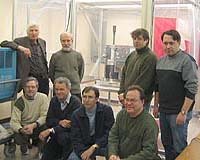
Astronomers, using Canada's suitcase-sized space telescope MOST (Microvariability & Oscillations of Stars), have discovered that the vibrations of a nearby sun-like star called eta Bootis are out of tune compared to the predictions of theoretical models.
Dr. David Guenther of Saint Mary's University, in Halifax, Nova Scotia, presented their new findings on behalf of the MOST Science Team Sunday at the Canadian Astronomical Society meeting in Montreal, QC.
The findings have also been submitted to The Astrophysical Journal for publication.
MOST has detected oscillations in the brightness of eta Bootis caused by sound waves bouncing around inside the star.
Comparing the oscillation frequencies to computer models reveals information about the star's otherwise invisible interior, just as you can tell by the sound alone whether you are listening to a stringed instrument like a violin or a brass instrument like a trumpet.
But as Dr. Guenther reveals, "My choir of theoretical star models are slightly out of tune compared to eta Bootis. Eta Bootis is telling us that we need to tweak our computer models."
Ultimately, the retuned models will help astronomers better understand our own star, the Sun.
"Much of what we know about stars, what powers them, how they evolve over time, how they produce the elements that make up life, and what their role is in the evolution of our Galaxy and the Universe, comes from computer models," explains Dr. Guenther.
"Our understanding of the Sun and other stars is only as good as our ability to match data to models. Better data from new instruments like MOST forces us to produce better models."
The computer simulations are now so sophisticated that the full computational resources at Saint Mary's University's Institute for Computational Astrophysics are needed, and even then they take over six months to calculate.
Eta Bootis is the third brightest star in the constellation Bootes, the Herdsman. In Canada we can see it during Spring. Follow the arc of the Big Dipper's handle away from the Dipper until you bump into Arcturus, the bright orange star.
Eta Bootis is the fainter star just to the right (when facing north) of Arcturus. Eta Bootis is 'only' two and a half billion years old, half the age of the Sun, yet is over twice the size and almost twice the mass of the Sun.
It has burnt up all the hydrogen fuel in its core and is just beginning to swell up, on its way to becoming a giant star over a hundred times the size of the Sun.
This is only one of many new findings being reported by the MOST science team at this year's Canadian Astronomical Society meeting.
The entirely Canadian-built satellite is the first designed explicitly to study stellar oscillations from space.
MOST is a Canadian Space Agency mission, operated jointly by Dynacon, the University of Toronto Institute of Aerospace Studies (UTIAS), and the University of British Columbia (UBC), with assistance from the University of Vienna.
