
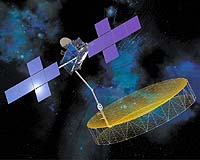
TerreStar Networks, a majority owned subsidiary of TerreStar Corporation (Nasdaq: TSTR), and Space Systems/Loral, the leading provider of commercial satellites today, announced that TerreStar-1 has arrived on schedule in Kourou, French Guiana where it is scheduled to launch on June 24th aboard the Ariane 5 heavy lift launch vehicle.
TerreStar-1 will be the largest commercial satellite ever launched and is designed to provide integrated satellite and terrestrial mobile services for critical communications using conventionally-sized dual mode handsets.
"The arrival of TerreStar-1 signals the start of final launch preparations," said Jeffrey Epstein, President of TerreStar Networks.
"Once launched, TerreStar-1 will allow us to deliver on the vision of an integrated satellite and terrestrial mobile service that enables next generation applications anytime, anywhere."
Dennis Matheson, TerreStar Networks Chief Technology Officer said, "The design, manufacture and delivery of TerreStar-1 has been a team effort.
"We have relied on our colleagues at Space Systems/Loral for their experience and support in delivering the integrated satellite and ground system that makes our new services possible. We now look forward to a flawless launch by our partner Arianespace."
"It has been a pleasure working with TerreStar Networks on this challenging project," said John Celli, President and Chief Operating Officer at Space Systems/Loral.
"With its 18-meter unfurlable reflector and extraordinarily powerful S-Band feed array, TerreStar-1 was designed to provide next generation capability for mobile devices."
Ideally suited to provide critical services to government, emergency responders, rural communities and commercial users, the satellite uses 2 GHz spectrum to provide voice, data and video communications to satellite/terrestrial mobile devices the size of a typical smart phone.
Space Systems/Loral, working with Hughes Network Systems, has developed a two-way ground based beam forming technology that enables the satellite to reallocate resources based on demand, thereby maximizing capacity.
TerreStar-1 is based on SS/L's 1300 space-proven platform, which provides the flexibility to support a broad range of applications and technology advances. The satellite will be capable of generating over five hundred spot beams covering the Continental U.S., Canada, Alaska, Hawaii, Puerto Rico and the U.S. Virgin Islands.
Share This Article With Planet Earth
