
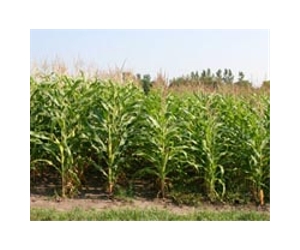
A genetically modified variety of corn produced by a U.S. supplier and banned in the European Union has been sown accidentally across Germany, as the conflict over GM food products continues.
The NK603 variety from U.S. company Pioneer Hi-Bred contaminated seeds sown in several states on at least 5,000 acres of farmland, according to findings by the environment ministry of Lower Saxony published by Greenpeace. The environmental group says at least 0.1 percent of the plants are contaminated.
Usually, this is prevented by extensive testing of seeds before they are sold.
"In all states, the affected seeds were removed from the market before they could have been sold," Alexander Hissting, an agriculture expert with Greenpeace told German public broadcaster NDR. "However, in Lower Saxony, officials let the seed tests rest results dust over on their desks for three months and that's why it couldn't be removed in time."
Pioneer disputes most of the findings.
Company spokesman Mike Hall told the BBC that the level of NK603 detected in the conventional seed was 0.03 percent.
"It's highly unlikely that it's a GM trace. Anything below 0.1 percent could be a false positive, impossible to quantify scientifically," he said. "In the past when they found trace amounts we removed the seed from the market. In this case they told us after it had been planted."
On Tuesday, the company's German branch launched a statement saying Pioneer "strongly rejects alleged findings of genetic modification in sown corn."
Officials from Lower Saxony have said the contaminated fields would be plowed before the plants bloom. In Germany, corn isn't only planted for use in food products but also as energy plants harvested to fuel biomass power plants.
Unlike in the United States, where GM corn crops are widely used (including the NK603 variety), the EU has taken a conservative approach, clearing only one type of GM corn and one type of GM potato for starch production.
Several EU members have banned both GM crops domestically; only Spain, Portugal and the Czech Republic allows them to be sown.
The European Commission would like to introduce more lax rules on GM crops but farmers in Germany say they fear that once the GM crops take over, a few seed suppliers can dominate the market and exploit farmers.
Share This Article With Planet Earth
