
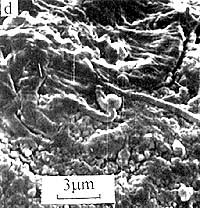
"The microfossls detected apparently represent the remains of microbial communities rather than remains of individual microorganisms; the communities were well developed and resembled cyanobacterial communities. The communities functioned in an aquatic enviroment, probably in hydrothermal volcanic activity zones.
At a conference in Denver, July 20-22, 1999, a pair scientists
from the Russian Academy of Sciences presented sharp images that
look very much like fossilized microorganisms taken from fragments
of several carbonaceous meteorites.
One of the scientists, Dr. Stanislav I. Zhmur of the Institute of the Lithosphere of Marginal Seas, RAS, wrotes;
"Comparative analysis of bacteriomorphic structures from the
carbonaceous meteorites, Murchison, Efremovka and Allende,… and
morphology of microorganisms of modern and ancient terrestrial
cyanobacterial community showed that they are analogous.
This gave us reason to consider that these bacteriomorphic structures are
fossilized remnants of microorganisms. The lithified remnants are tightly conjugated with the mineral matrix, removing the possibility that they are contaminants.
The selection of microfossils capable of being interpreted as biological is quite wide. Some of them are demonstrated in the pictures."
The photos were first published at a conference sponsored by the
International Society for Optical Engineering (SPIE), entitled
"Instruments, Methods and Missions for Astrobiology II." It was
organized by by NASA's Richard Hoover. The proceedings of the July
conference became available in December.
See full article for detailed images and additional text (460K)
1. Stanislav I. Zhmur and Lyudmila M. Gerasimenko. "Biomorphic forms in carbonaceous meteorite Alliende and possible ecological system – producer of organic matter hondrites" in Instruments, Methods and Missions for Astrobiology II, Richard B. Hoover, Editor, Proceedings of SPIE Vol. 3755 p. 48-58 (1999).
