
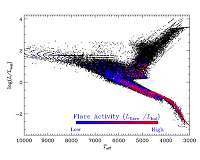
The study of stellar activity associates many aspects of stellar physics. In the past 40 years, the understanding of stellar activity and its relation with stellar structure and evolution has obtained great progress. One landmark is the discovery of the activity-rotation relation, which indicates the connection between stellar activity and stellar evolution.
However, there are still some fundamental issues to be addressed: why is there a sharp turnoff in the relation and what is the implication of this relation for stars with different dynamos?
Recently, research led by Dr. Yang Huiqin at National Astronomical Observatories of Chinese Academy of Sciences (NAOC) has addressed the relation among activity, dynamo, stellar structure, and evolution in terms of the flare activity. They propose a new expression on the activity-rotation relation, which could be an important step in the study of stellar activity.
This study presents a unique method and analysis, which has advantages over the traditional approaches for the study of stellar activity. "Thanks to the Kepler mission, it enables us to conduct a systematic study on flares, which could gauge the classical theories from the view of flares. It is important for us to grasp a whole picture and connect various factors for stellar activity," said Prof. Liu Jifeng, the coauthor of this study.
Yang et al. calculate the flare activity of more than 3,400 flaring stars for almost all types of stars. They find that the activity-rotation relation in late-type stars is consistent with previous studies.
However, as they consider this relation on a wider scope – that is, across H-R diagram, one interesting fact is that this relation gradually becomes dispersive as the temperature increases and nearly disappears in early-type stars.
"One intriguing question is what is the nature behind this trend, since the Rossby number is considered as the unique variable in stellar activity by previous studies," said Dr. Yang Huiqin. The study answers this question by proposing a scenario, in which the dynamo is the key point on revealing the relation among activity, structure, and evolution.
"We present the overall picture of the activity-rotation relation. It has a dynamic variation across the H-R diagram, and this variation inspires us to reassess the classical activity-rotation relation," said Prof. Liu.
They thereby suggest a new expression on the activity-rotation relation, which reflects the physical nature and is applicable for all type of stars. This study has been accepted for publication in The Astrophysical Journal Supplement Series.
Yang Huiqin, as the first author of this study, is a doctor from NAOC, who is interested in stellar activity, structure, and evolution. Liu Jifeng, as the coauthor, is a professor at NAOC, who has widespread interest on compact objects and stellar physics. This study is supported by National Science Foundation of China.
The paper includes data collected by the Kepler mission. Funding for the Kepler mission is provided by the NASA Science Mission Directorate.
