
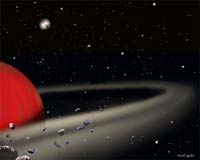
Astronomers said they have found planetary disks emerging independently of new stars or brown dwarfs. The disks have formed around planetary-mass objects, called planemos, and seem to be floating freely in space, after springing out of star-forming regions within the Milky Way galaxy.
Reporting this week at the American Astronomical Society meeting in Calgary, Alberta, astronomer Ray Jayawardhana of the University of Toronto and colleagues said they used the European Southern Observatory's telescopes in Chile to obtain temperature profiles of two planemos with masses between five and 10 times Jupiter's, and two others 10 to 15 times Jupiter's mass.
All four objects are hot, meaning they are just a few million years old, and all are located within about 450 light-years from Earth.
"Now that we've discovered these planetary-mass objects with their own little infant planetary systems, the definition of the word 'planet' has blurred even more," Jayawardhana said. He added that he thinks the discoveries should come as no surprise, however, because Jupiter and its moons all formed from the same disk – though they were born as part of the local solar system.
One of the planemos, 2M1207B, is located about 170 light-years away in the direction of the constellation Centaurus. It orbits at about 40 astronomical units, or 3.7 billion miles, from a 25-Jupiter-mass brown dwarf – itself surrounded by a protoplanetary disk. That is a wide separation for binary brown dwarf systems, so the researchers think the objects formed far away from stars that could have pulled them apart.
"This system probably won't survive for long," said co-lead researcher Subhanjoy Mohanty, an astronomer at the Harvard-Smithsonian Center for Astrophysics in Cambridge, Mass. "It won't last 5 billion years like our solar system has." All it would take, he added, is for a more massive object to pass by and pull the planemo away from its companion, changing its classification to a more conventional solar system member.
"It is amazing to think of what other kinds of (lower-mass) rogue planets could be out there, and if life could exist on such forsaken bodies," Sara Seager, an astrophysicist with the Carnegie Institution in Washington, D.C., told SpaceDaily.com.
Seager cautioned, however, that the true masses of the planemos are not yet known and could be larger than expected. "This is because mass is assigned by comparing the measured heat to thermal evolution models," Seager said, "models that are highly uncertain at young ages."
Despite that uncertainty, she said, "this is still a significant discovery."
