
An international team of astronomers said they have discovered a new type of cosmic object – small, compressed neutron stars that exhibit no activity most of the time, but once in a while they emit a single, short burst of radio waves.
Reporting in the Feb. 16 issue of the journal Nature, astronomers from the United Kingdom, United States, Australia, Italy and Canada said the new objects – which they call rotating radio transients or RRATs – probably are related to conventional radio pulsars – small stars that emit regular pulses of radio waves, up to hundreds of times per second. The new objects also might far outnumber their old cousins.
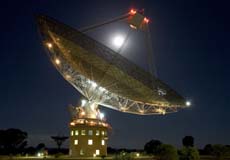
The astronomers, using the CSIRO Parkes radio telescope in eastern Australia, so far have found 11 RRATs, all first detected by the telescope's Multibeam Pulsar Survey, and then observed again several times. All of the objects emit isolated radio bursts that last for periods running between 2 milliseconds and 30 milliseconds. In between the bursts, however, for periods ranging from four minutes to three hours, they remain silent.
"These things were very difficult to pin down," said team member Dick Manchester of CSIRO, a veteran pulsar hunter. "For each object we've been detecting radio emissions for less than one second a day, and because these are single bursts, we've had to take great care to distinguish them from terrestrial radio interference."
by analyzing the burst arrival times, the astronomers have found 10 of the 11 sources also have underlying periods running from 0.4 seconds to 7.0 seconds, a factor that suggests they are rotating – but more slowly than conventional pulsars.
Because the RRATs maintain radio silence most of the time, the team wrote, their chances of being detected are low. Therefore, the scientists think many more must be lurking unseen in the Milky Way – perhaps as many as a few hundred thousand. The estimated number of normal radio pulsars in the galaxy is about 100,000.
Unlike other kinds of stars that show periodic eruptions, the RRATs exhibit no evidence of residing in binary systems. A handful of conventional pulsars also produce occasional giant pulses, along with their usual train of regular, smaller pulses, but the RRATs seem to differ from these stellar bodies because their magnetic field strengths in the emission region are about 100,000 times weaker, the team wrote.
