
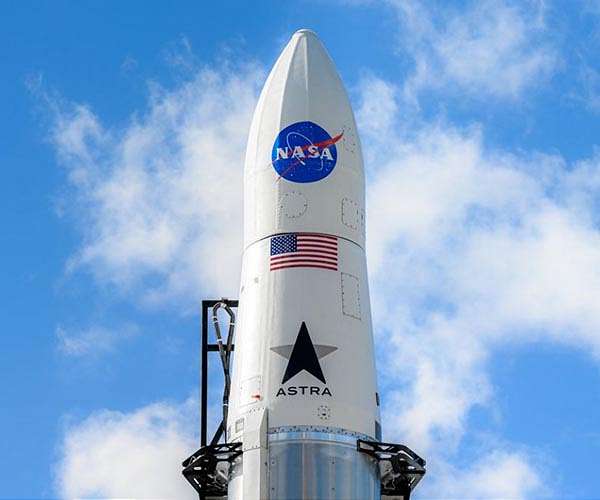
The planned launch of an Astra Space rocket from Florida was scrubbed Saturday after the failure of ground equipment needed to launch.
"Unfortunately, due to a range asset that has gone out of service today, we are going to stand down from today's launch attempt of the ELaNa 41 Mission," said Carolina Grossman, director of product management at the company, during the live broadcast.
"Our launch window does extend to tomorrow as well, at the same time."
It was not immediately clear what range asset had gone out of service and if the problem could be corrected before the launch window Sunday.
Chris Kemp, the founder and chairman of the company, said on Twitter that "a range equipment failure caused a critical range detection asset to be unavailable to support our launch."
Florida's Space Coast had planned to host a NASA space launch Saturday by Astra, the first company expected to launch from the region since SpaceX first launched from Florida over a decade ago.
Astra, which is based in California, planned for its small rocket to lift off at 1 p.m. EST from Complex 46 at Cape Canaveral Space Force Station. The company then announced a 1-hour delay of the original launch time before it was ultimately scrubbed.
Astra previously tested its rocket in California and launched from Alaska.
The rocket will carry four very small satellites, or CubeSats, designed by NASA and university students to conduct space experiments under a 2020 NASA contract award of $3.9 million to Astra Space and two other new launch companies.
NASA's mission name for the spaceflight is ELaNa 41, which stands for Educational Launch of Nanosatellites.
Astra received final word of its fast-tracked Federal Aviation Administration license for the launch on Friday, the company announced on Twitter on Friday evening.
The license is the first the agency has issued under Part 450, a new rule that attempts to streamline the licensing process.
"Astra's new launch license was issued in just three months and it is expected to, with planned modifications, make it easier for Astra to launch at a higher frequency out of more launch sites in the United States," publicly traded Astra announced in a filing with the U.S. Securities and Exchange Commission.
Astra's rocket is relatively small, at just over 38 feet, compared to SpaceX's Falcon 9, which is more than 229 feet high.
The satellites are:
+ BAMA-1, designed by University of Alabama, to test a type of spacecraft sail that would create drag in the upper atmosphere, leading to rapid deorbiting of the craft.
+ INCA, designed by New Mexico State University, which stands for Ionospheric Neutron Content Analyzer and will study the neutron spectrum in low-Earth orbit.
+ QubeSat, by University of California, Berkeley, which will test and characterize the effects of certain conditions on quantum gyroscopes in space.
+ R5-S1, designed by NASA's Johnson Space Center in Houston to demonstrate a fast and cost-effective way to build very small satellites by demonstrating some in-space camera inspection.
