
The explosion of a large asteroid some 8.3 million years ago showered the Earth with so much dust that the planet's climate system may have cooled, a study published on Thursday says.
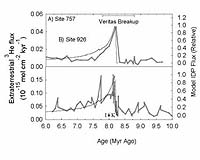
California Institute of Technology (Caltech) researchers say that cores drilled into sea sediment show peaks in 3He — a non-radioactive isotope of helium that is rare on Earth but representative of interplanetary dust.
These peaks coincide with other research data pointing to a "modest global cooling" and a strengthening of Asia's monsoon cycle.
The increased dust shower lasted for about 1.5 million years, the scientists report in the weekly issue of Nature, the British weekly science journal.
The asteroid's breakup is believed to have caused the so-called Veritas family of orbiting rocky debris.
There have been numerous periods of climate cooling in Earth's history, most of them attributed to atmospheric concentrations of dust, such as volcanic eruptions or soil particles kicked up by a collision with asteroids or comets.
Source: Agence France-Presse
