
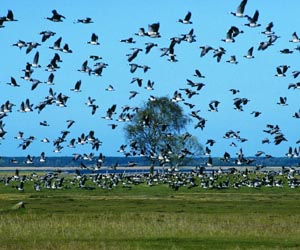
Waterbird populations in Asia are shrinking at a faster rate than anywhere else in the world as rapid economic growth and urbanisation destroy their habitats, according to a study released Thursday.
The environment for waterbirds across the world is generally poor with a decline in many populations recorded in the three decades to 2005, said the report released by Wetlands International at a biodiversity summit in Japan.
However, while the picture for waterbirds in North America and Europe improved overall thanks to strong conservation legislation, 62 percent of all populations decreased or became extinct in Asia, Wetlands International said.
"The combination of a rapid economical growth and weak conservation efforts (in Asia) appears to be lethal," Wetlands International said.
"Waterbird populations are exposed to a wide range of threats such as the loss and degradation of marshes and lakes, water regulation, agricultural intensification, hunting and climate change."
Global warming was expected to pose an increasing danger for waterbirds in Asia and elsewhere, particularly because of changes in the Arctic, which is a vital breeding area for many species.
The tundra wetlands of the Arctic will decrease as the globe warms, wrecking the breeding grounds for hundreds of birds that migrate as far away as southern Africa, Australia and South America, the report said.
The report was released as delegates from 193 members of the UN's Convention on Biological Diversity were meeting in the Japanese city of Nagoya to try to work out strategies to stop the rapid loss of the world's biodiversity.
The summit is due to end on October 29 with delegates aiming to set a new set of targets for curbing species loss by 2020.
earlier related report
'Runaway' evolution spreading toads
Townsville, Australia (UPI) Oct 20, 2010 –
A runaway evolutionary effect is accelerating the spread in Australia of the invasive cane toad species, scientists say.
Researchers say toads living at the very edge of their range have evolved into "super-invaders" able to move beyond the boundaries of their existing habitat, the BBC reported Wednesday.
And when toads at those frontiers breed, researchers say, their offspring are inheriting this capability of moving into new territory.
Scientists have observed that toads at the edge of the range had bigger front legs and stronger back legs, equipping them to more effectively jump into and invade new areas.
To confirm this increased strength and speed had a genetic basis and could be inherited, researchers studied the next generation.
Toads that had parents from the frontiers of their range proved to be stronger and faster than offspring of frogs inhabiting the central region of their range, showing the traits had been passed on.
"It's bad news," one researcher said. "It means they're getting faster and better at invading new areas."
Even worse, Ben Phillips from James Cook University in Queensland says, all animal invasions are likely to follow this pattern.
Cane toads were introduced to north tropical Queensland in Australia in 1935 to control sugar cane pests.
They failed to do this, but managed to become one of the International Union for the Conservation of Nature's top 100 invasive species.
"They're certainly up there with the worst invasive species," Phillips says. "They're doing well for themselves, you have to give them that."
Share This Article With Planet Earth
