
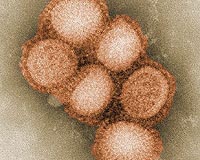
The rate of new British swine flu cases has fallen further, officials said Thursday, but confirmed plans to vaccinate vulnerable people from October, when a second wave is expected.
There were 25,000 new cases of swine flu in England over the past seven days, compared to 30,000 last week and 110,000 the week before, according to the Health Protection Agency (HPA), in its latest weekly update.
Britain has the highest number of cases in Europe, mostly in school outbreaks. Experts believe the number of new cases should continue to fall while schools and universities are on their summer holidays.
The overall number of deaths in Britain has risen to 49 — 44 in England and five in Scotland — while there have been no swine flu-related deaths so far in Wales or Northern Ireland.
Despite the rise of deaths, the number of new cases dropped by a sixth in England. Some 371 new patients were admitted to hospital in the past week, down from 530 the previous week.
"This week there has been a further reduction in the rates of flu-like illness and related activity," the HPA said.
"The majority of cases continue to be mild. There is no sign that the virus is changing. It is not becoming more severe or developing resistance to anti-virals.
"Disease severity continues to be monitored. The disease is generally mild in most people so far, but is proving severe in a small minority of cases."
Chief Medical Officer Liam Donaldson said that people in priority groups — including pregnant women and children — would start receiving vaccinations in October.
This month, 300,000 doses of the vaccine have been delivered by the manufacturers and 54.6 million doses will have arrived by the end of the year.
Trials on the vaccines are taking place this month and the European Medicines Agency is expected to licence the drug in late September or early October, according to British officials.
earlier related report
Australian swine flu deaths pass 100
The majority of Australians coming down with influenza have swine flu, authorities said Thursday, as the number of deaths linked to the virus passed 100.
Health Minister Nicola Roxon said adult trials of an A(H1N1) vaccine were progressing well, but could not confirm that the disease, which had hit 28,987 people and killed 102, was past its forecast August peak.
"It is well and truly the dominant strain of flu that is circulating in Australia this season," said Roxon.
"We're not clear that the thing has peaked, but we will say that (the number of deaths) has been a very unfortunate, but good, result in terms of trying to keep control of this."
Almost one-third of people presenting to hospital with swine flu were ending up in intensive care, with "particularly concerning" damage to their lungs, said Jim Bishop, Australia's chief medical officer.
There were 449 people in hospital with the disease, Roxon said, with 109 in intensive care.
A mass immunisation program of at least half Australia's population is scheduled to begin in October, and Roxon said the results of vaccine trials would not be available for a number of weeks yet.
Pharmaceutical company Biota, whose flagship product is the anti-viral flu drug Relenza said Thursday it would hand over 20 million dollars (16.77 million US) to its shareholders due to overwhelming returns from the drug.
Since the virus first emerged in Mexico in April, it has spread globally, reaching pandemic level and affecting nearly every country in the world, according to the World Health Organization.
The UN body said Wednesday that its tally of swine flu deaths had risen to 1,154 from the 816 announced on July 27, and the illness was now found in 168 countries and territories.
Share This Article With Planet Earth
