
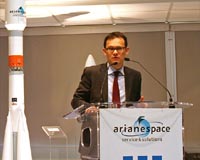
Arianespace remains on track for record operational and commercial performances in 2015, building on the company's long-term commitment to meeting customer requirements with a capable launcher family offering mission flexibility, reliability and availability.
This was the message of Arianespace Chairman and CEO Stephane Israel to international reporters during a press briefing today at the opening of the World Satellite Business Week event in Paris.
He said 13 launch services contracts already have been signed in 2015, involving all three members of the company's launch vehicle family: the heavy-lift Ariane 5, medium-lift Soyuz and lightweight Vega.
Arianespace's overall order book now incorporates 56 future missions to be performed for 35 customers, with additional contract signatures anticipated before year-end, Israel added .
A strong order book
The current Arianespace order book involves payloads to be lofted on 21 Ariane missions, along with 25 launches for Soyuz and 10 with Vega.
This new business further validates the capability of Arianespace's launcher family in responding to a full range of customer requirements, Israel told reporters, and results in an equal division between the number of geostationary and non-geostationary payloads.
It also provides a balance of large and smaller satellites – an important element for the company's match-up of payloads on dual-passenger Ariane 5 missions.
For Arianespace's 2015 operations, Israel confirmed the goal of performing a record 12 missions this year at the service of international commercial customers and European institutions.
Four flights planned before year-end
Building on the eight successful launches already achieved in 2015 (four conducted with Ariane 5, two utilizing Soyuz, and two with Vega), the company has scheduled the following four flights before year-end:
+ Two Ariane 5 missions with geostationary-orbit telecommunications satellites, launching the Australian Sky Muster and Argentinian ARSAT-2 payloads on September 30, and another liftoff scheduled for November 5 with Arabsat 6B and GSAT-15,
+ A Vega mission in late November, which will place the European Space Agency's Lisa Pathfinder space science mission on a trajectory to deep space, and
+ A Soyuz flight to medium-Earth orbit, targeted for mid-December with two more European Galileo navigation satellites.
A roadmap for the future
During his briefing to reporters today, Israel spoke about Europe's long-term vision for its continued access to space, which includes this year's go-aheads for a next-generation Ariane 6 and an evolved Vega C version.
These steps are part of a roadmap that will maintain Arianespace's competitiveness in a changing marketplace, he added.
Israel also addressed Arianespace's ability to accommodate satellite constellations of the future, many of which are envisioned to involve large numbers of very small-sized ("micro") spacecraft.
He said a "micro launcher" – capable of deploying constellation payloads of approximately 300 kg. to low Earth orbits – could be of interest as a potential addition to the company's launch vehicle portfolio.
"We are ready to listen to the market as concepts for such constellations take shape, and Arianespace is open to discussions on possible launch services solutions complementary to our launcher family," Israel concluded.
"The space sector has a role to play in meeting demands of increased connectivity for those already connected, and to connect those who currently do not have access."
