
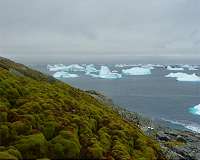
Plant life on Antarctica is growing rapidly due to climate change, scientists have found.
Few plants live on the continent, but scientists studying moss have found a sharp increase in biological activity in the last 50 years. A team including scientists from the University of Exeter used moss bank cores – which are well preserved in Antarctica's cold conditions – from an area spanning about 400 miles.
They tested five cores from three sites and found major biological changes had occurred over the past 50 years right across the Antarctic Peninsula.
"Temperature increases over roughly the past half century on the Antarctic Peninsula have had a dramatic effect on moss banks growing in the region," said Dr Matt Amesbury, of the University of Exeter.
"If this continues, and with increasing amounts of ice-free land from continued glacier retreat, the Antarctic Peninsula will be a much greener place in the future."
Recent climate change on the Antarctic Peninsula is well documented, with warming and other changes such as increased precipitation and wind strength.
Weather records mostly began in the 1950s, but biological records preserved in moss bank cores can provide a longer-term context about climate change.
The scientists analysed data for the last 150 years, and found clear evidence of "changepoints" – points in time after which biological activity clearly increased – in the past half century.
"The sensitivity of moss growth to past temperature rises suggests that ecosystems will alter rapidly under future warming, leading to major changes in the biology and landscape of this iconic region," said Professor Dan Charman, who led the research project in Exeter. "In short, we could see Antarctic greening to parallel well-established observations in the Arctic.
"Although there was variability within our data, the consistency of what we found across different sites was striking." The research team, which included scientists from the University of Cambridge and British Antarctic Survey, say their data indicate that plants and soils will change substantially even with only modest further warming.
The same group of researchers published a study focussing on one site in 2013, and the new research confirms that their unprecedented finding can be applied to a much larger region.
Plant life only exists on about 0.3% of Antarctica, but the findings provide one way of measuring the extent and effects of warming on the continent.
The paper, published in the journal Current Biology, is entitled: "Widespread biological response to rapid warming on the Antarctic Peninsula."
The research was funded by the Natural Environment Research Council (NERC).
The researchers now plan to examine core records dating back over thousands of years to test how much climate change affected ecosystems before human activity started causing global warming.
Antarctic has seen widespread change in last 50 years, moss study reveals
London, UK (SPX) May 22 – In 2013, researchers studying mosses and microbes growing at the southern end of the Antarctic Peninsula documented unprecedented ecological change over the last 50 years, driven by warming temperatures. Now, the same research group has confirmed that those striking changes in the Antarctic are widespread, occurring all across the Peninsula. The findings appear in Current Biology on May 18.
"This gives us a much clearer idea of the scale over which these changes are occurring," says lead author Matthew Amesbury of the University of Exeter. "Previously, we had only identified such a response in a single location at the far south of the Antarctic Peninsula, but now we know that moss banks are responding to recent climate change across the whole of the Peninsula."
The Antarctic Peninsula is known to have been one of the most rapidly warming regions on Earth. Annual temperatures there have crept up about 0.5C each decade since the 1950s. The researchers realized they could learn a lot about how rising temperatures have affected the ecology of the Peninsula by studying core samples taken from moss banks established more than 150 years ago.
In the new study, the researchers added an additional three sites and five cores to their earlier sample. Those sites include three Antarctic islands (Elephant Island, Ardley Island, and Green Island) where the deepest and oldest moss banks grow, representing a 600-kilometer transect along the Peninsula.
Careful analysis of those five cores going back 150 years showed increased biological activity as the Peninsula has warmed in the last 50 years. Those findings suggest that the Peninsula is undergoing fundamental and widespread change. Amesbury noted that the consistency of changes in the moss samples taken from different parts of the Peninsula was particularly striking.
There's more to come, the researchers say. The sensitivity of mosses' rate of growth in response to past temperature increases suggests that terrestrial ecosystems of the Antarctic Peninsula will continue to experience rapid change with future warming.
"Temperature increases over roughly the past half century on the Antarctic Peninsula have had a dramatic effect on moss banks growing in the region, with rapid increases in growth rates and microbial activity," says Dan Charman, who led the research in Exeter. "If this continues, and with increasing amounts of ice-free land from continued glacier retreat, the Antarctic Peninsula will be a much greener place in the future."
The researchers say they'll continue to examine core records stretching back in time over thousands of years. Their goal is to explore the impact of climate change on terrestrial ecosystems before humans began heating things up.
Antarctica is greening due to global warming
Plant life is growing on Antarctica like never before in modern times, fueled by global warming which is melting ice and transforming the landscape from white to green, researchers said Thursday.
Scientists studying moss in an area spanning 400 miles (640 kilometers) have found a sharp increase in growth over the past 50 years, said the report in the journal Current Biology.
Plant life e … read more
