
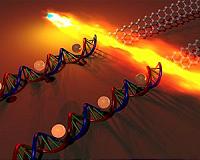
Scientists at Caltech have developed a new type of polymer that prevents fuel from misting during an explosion. The breakthrough could decrease the amount of damage caused by industrial accidents and terrorist attacks.
Had the new polymers been added to the fuel of American Airlines Flight 11 and United Airlines Flight 175, the Twin Towers might have survived the 9-11 terrorist attacks.
When members of al-Qaeda flew a pair of jumbo jets into the World Trade Center on September 11, 2001, the engines and fuel tanks exploded upon contact, spitting out a fiery mist of fuel. The ignited mist blew out hundreds of window, increasing the flow of oxygen to the resulting fire. The explosion also damaged concrete reinforcements and stripped away a protective coating from the buildings' steel beams.
The misting effect amplified the damage caused by the two crashes.
Scientists at the California Institute of Technology were inspired by the 9-11 tragedy to develop a polymer to prevent fuel from being exploded into mist.
Other groups of researchers have previously deployed "ultralong" polymers in an attempt to curb fuel misting. The polymers succeeded in dissipating the explosive energy that divides fuel into tiny particles of mist, leading to smaller, shorter fires. However, the polymers interfere with engines and turbines, and they break apart while traveling pipelines, making them impractical and ineffective.
Scientists at Caltech developed polymers that attach to one another via carboxylic acid and amine groups to create "megasupramolecules." The polymers are as long as ultralong polymers, but they don't degrade when traveling through pipelines. In fact, they speed up the flow of fuel.
The megasupramolecules also don't interfere with engines.
"The new molecules have reversible linkages that are strong enough to give the benefits of ultralong polymers and weak enough that they 'let go' before the tension anywhere along the chain is high enough to break covalent bond," researcher Julia Kornfield told UPI. "The resulting free ends are able to pair up with other megasupramolecules to recover completely. In effect, they self-repair."
Scientists tested their new polymers in fuels, using high speed cameras to track the misting effect. The results, presented this week at the American Chemical Society's national meeting in Orlando, Florida, showed megasupramolecules work to reduce the temperature, size and burn time of fires resulting for exploded fuel.
Researchers calculated that the polymers would add one cent per gallon to the cost of fuel. Kornfield and her colleagues are working with industry partners to bring down the costs. In the future, Kornfield hopes the polymers will be added to all industrial fuels.
"Megasupramolecules can be added at the refinery or at a fuel depot or at the point of fueling. Their resistance to degradation opens all options," she said. "The most economical is to add Megasupramolecules to fuel at a refinery, where their presence reduces the cost of moving the fuel through pipelines and that my offset their cost."
The U.S. Army is planning to test the effect of polymer additives on fuel exploded by impacts and projectiles, or by an improvised explosive device.
