
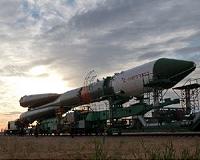
In the past three weeks Russia has suffered three serious launch and in-space failures. Just three weeks ago, Russia launched Progress 59, loaded with propellants, food and supplies bound for the International Space Station. Apparently, by the time the spacecraft reached its initial orbit something had gone terribly wrong.
Russian Mission Control made repeated attempts to regain control, but control of the 7.2-meter high spacecraft, carrying over 2,000 kg of payload, could not be achieved. All attempts to rescue the vehicle failed, and Progress 59 reentered the atmosphere over the Pacific Ocean just after midnight eastern time on May 8th.
This meant complete loss of the mission, spacecraft and cargo. As a result space station crew operations and schedules have been impacted and resupply schedules will certainly change.
To further complicate matters, just three days ago, failure struck Russia's space program again. A Proton launch vehicle carrying the MexSat-1 communications satellite experienced a third-stage malfunction and the mission was lost. About the same time a Progress module attached to the space station had to abort a planned reboost maneuver.
In summary, we have two Progress modules that failed and the loss of a Proton launch vehicle. The impact of the Progress 59 failure, although expensive, will not cause serious supply problems for the station's crew. Alternative options are available and the crew has ample supplies.
The Proton loss, while also expensive, will result in a delay for the Mexican satellite program. Failure to reboost the station, if delayed too long, could result in the unintended reentry of the very large space vehicle. Most people do not realize the ISS has a mass of 450,000 kg (almost one-million lb). However, there is no immediate danger of this happening, immediate danger of this happening, because there are alternative options available for reboost including further attempts at restarting the Progress module engines.
The Russian situation represents a small part of the business of space flight. Many professionals working in important space-related positions who have not had formal training in astronautics must understand and be aware of the many activities among space-faring nations.
Launchspace has developed a special short course for those professionals who need to be conversant with key aspects of space flight, launch vehicles and in-orbit operations. See the course description below and contact Launchspace for details on a course presentation at your facility.
