
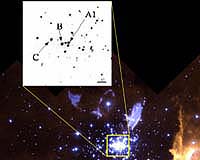
Although stars with masses reaching up to 150 times the mass of the Sun are expected in the local Universe, no one has reliably found a star exceeding 83 solar masses so far. Until now that is. A team of astronomers from Universite de Montreal has identified the most massive star ever weighed. The details are being presented today by Professor Anthony Moffat at the annual meeting of the Canadian Astronomical Society (CASCA) held at the Royal Military College of Canada in Kingston (ON).
This team has "weighed" a star in a binary system with a mass of 114 times the mass of the Sun, thus breaking the 100 barrier for the first time. Even its companion is no slouch, with 84 solar masses. The 3.7724-day orbiting binary star carries the rather unromantic name of A1, the brightest hot star right at the heart of a giant but dense, young star cluster called NGC 3603, located in the southern Milky Way at a distance of some 20,000 light-years.
The high masses were obtained simultaneously from Doppler orbits for both of A1's stars using a specially developed new instrument at the European Very Large Telescope (VLT), combined with eclipses obtained using the Hubble Space Telescope, all in the near infrared. Both stars in the A1 system are so massive and luminous that they show emission characteristics that one normally only sees in the exotic, so-called Wolf-Rayet stars.
Among the two other similar bright, hot stars close to A1 at the core of NGC 3603, a star dubbed "C" was also found to be a binary with a period of 8.92 days, although definitive masses for its components, also expected to be high, are not yet available. The team is currently working on several other similar candidate very massive stars in other parts of our Milky Way and its dominant satellite galaxies known as the Magellanic Clouds.
The physics of massive stars
