
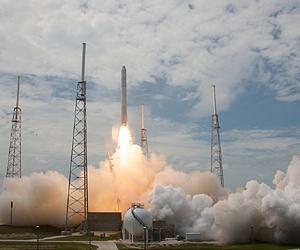
Space Exploration Technologies (SpaceX) successfully launched its new Falcon 9 last Friday. This was the first attempt for a new large launch system that will compete in the world marketplace providing launch services for government and commercial payloads.
Unlike the two EELV systems, Atlas V and Delta IV, this vehicle was developed in an entrepreneurial environment with financial backing and direction from Elon Musk, co-founder of PayPal and now "rocket entrepreneur."
Although this launch did not carry a paying customer, it did successfully place a dummy payload into orbit. SpaceX originally had planned to develop the Falcon 5, a smaller vehicle which was to follow the Falcon 1.
However, retirement of the Space Shuttle and the need for a new American vehicle to service the ISS led Elon to develop the Falcon 9 and bypass the Falcon 5. Although SpaceX funded the first Falcon 9 flight, subsequent flights will be funded under a NASA contract called Commercial Orbital Transportation Services, or COTS.
Historically, this launch may prove particularly important because it provides credibility and support to the President's proposed shift in national space priorities, i. e., turning U.S. LEO launch capabilities over to private sector companies such as SpaceX and allowing NASA to focus on deep space exploration. At the same time the Falcon 9 success offers hope for America's "life-after-shuttle" space activities.
SpaceX plans to use the Falcon 9 for both cargo and crew-transfer missions to the ISS and at a much lower cost than using the shuttle. A first success is a good start, but the road ahead can be risky, especially when Falcon starts flying astronauts to orbit. We will have to stay tuned over the next few years to see if the promise of low-cost space transportation becomes a safe reality.
Orbital Sciences also is developing an ISS cargo craft under NASA's Commercial Orbital Transportation Services/Commercial Resupply Service (COTS/CRS) Program using its new Taurus II launch system. The first flight is expected next year.
Launchspace will continue to track commercial space advances.
Share This Article With Planet Earth
