
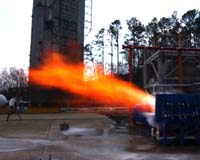
Alliant Techsystems announced Monday it will help develop a non-toxic liquid oxygen-liquid methane rocket engine for use on NASA's Crew Exploration Vehicle under a $10.4 million technology-development contract from the agency.
The contract is part of NASA's overall effort to improve the economy of human space exploration, ATK said in a statement.
NASA's Exploration System Architecture studies have identified a non-toxic LOx-Methane propulsion system as a preferred candidate for future CEV architecture, because it eliminates special ground handling procedures associated with traditional nitrogen tetroxide and monomethyl hydrazine propulsion systems. Non-toxic engines could significantly reduce the cost of fueling and servicing operations.
The CEV, scheduled to begin flight operations sometime after NASA retires its space shuttle fleet in 2010, will transport astronauts and cargo to the International Space Station and, eventually, to the Moon and perhaps Mars. If NASA could perfect the LOx-methane propulsion system, it could use it for both the CEV Service Module main engine and on the ascent stage of the next-generation lunar lander.
Under the contract's terms, ATK will design, develop, fabricate, test and evaluate a prototype LOx-liquid methane rocket engine producing 7,500 pounds of constant thrust.
The contract also contains options to design and fabricate a heavier prototype engine that demonstrates multiple restart capabilities to support lunar exploration as well as missions to Mars. The contract is designed to develop new technologies that raise the CEV engine's Technology Readiness Level and determine its production feasibility.
Marshall Space Flight Center, in Huntsville, Ala., will implement the contract under the Propulsion and Cryogenic Advanced Development Project, managed by NASA's Glenn Research Center, in Cleveland, Ohio.
