
SpaceDev has been awarded a contract to design small kick-stage motors for microsatellite applications. The Company's Integrated Space Systems, Inc. (ISS) wholly owned subsidiary will provide research support for "Streamlined Launch Services" and "Low Cost Space Technology Demonstrations" to the United States Office of Space Launch. The total value of the 9-month contract is worth $687,700.
ISS will study various system designs for a Secondary Payload Orbital Transfer Vehicle, or SPOTV. These concepts will employ key elements of the hybrid-rocket technology acquired by SpaceDev last year from the defunct American Rocket Company. AMROC spent millions of dollars in the 1980s and early 90s developing and extensively testing low-cost hybrid-rocket technology, but failed to find commercial support.
For decades, launch vehicles like those manufactured by Lockheed Martin, Boeing, and Orbital Sciences, have accommodated small "piggyback" spacecraft — secondary payloads — but few had any means of changing orbits once deployed from their host launch vehicle.
"ISS has identified a widespread need for small and inexpensive propulsion and guidance modules that can boost small secondary payloads from their drop-off orbits to more desirable orbits," said Phil Smith, President of ISS. "Our goal is to make secondary payloads become primary payloads."
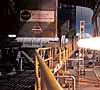
Hybrid technology employs cylindrical cases filled with a solid, storable and relatively inert propellant material as fuel, fed by an appropriate gas or liquid as the oxidizer. Unlike other all-solid spacecraft kick-stages, hybrid motors can be restartable and throttleable, which allows for greater in-orbit operational flexibility.
The ISS micro kick-motors are designed to be low-cost, highly versatile, non-toxic, storable, restartable, throttleable, modular and scalable. They will be compatible with selected expendable launch vehicles, the Space Shuttle and future reusable launch vehicles.
"This new project allows us to accomplish another set of meaningful steps toward our goal of being the key provider of low-cost commercial microsatellites and systems for Earth orbit and beyond," said Jim Benson, Chairman and CEO of SpaceDev.
"The micro-spacecraft market is growing exponentially, and SpaceDev has already become a globally recognized leader in the field. An inexpensive kick stage like SPOTV enables microspacecraft to do missions they normally couldn't perform.
"This could help get more small satellites launched by opening additional launch opportunities and fuel the demand for more small satellites like our MicroSil FedSat project for Australia," added Benson.
