
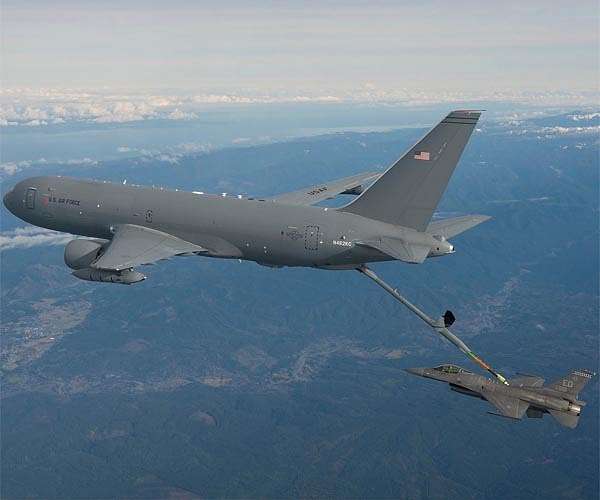
The Air Force has cleared the KC-46 aerial refueling tanker for limited, non-combat flights, officials said this week.
The tanker still needs a new refueling system, new boom, and more testing with some of the military's key aircraft, and those modifications will keep the tankers away from the battlefield for at least two more years, Gen. Jacqueline Van Ovost, the head of Air Mobility Command, said.
But the decision to clear the tanker will free up some KC-135 and KC-10 tankers for overseas assignments.
"What changes with this approach is we will now commit the KC-46 to execute missions similar to the ones they've been conducting over the past few years in the operational test and evaluation plan, but can now include operational taskings from U.S. Transportation Command," Van Ovost said.
The KC-46 is cleared to refuel B-52 bombers and F-15, F-16, and F/A-18 fighters over the Atlantic and Pacific Oceans, but still cannot refuel an A-10 attack jet, nor the F-22 and F-35 stealth fighters and the B-1 bomber.
"I remain confident that accepting the KC-46A with known deficiencies offers the fastest route to fielding a fully operational weapon system," Van Ovost said. "That said, serious deficiencies and restrictions remain with the KC-46A weapon system, and Boeing is still responsible for installing Remote Visual System 2.0 and redesigning the boom telescope actuator."
The Air Force awarded Boeing with two contracts to build KC-46A tankers in January: one worth $2.1 billion and one worth $1.7 billion.
The tanker was supposed to be ready for operations in 2017, but faced delays due to quality control issues, including malfunctioning cargo locks and its boom telescope actuator.
It is not expected to be combat-ready until 2023.
