
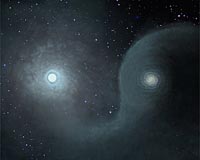
The visually bright winter constellation star Epsilon Aurigae, near Capella (Alpha Aurigae), is noteworthy for its 2-year-long eclipses that occur only every 27 years. It was first noted as a variable star in 1821 by Johann Fritsch of Germany.
Humanity has witnessed and documented only eight eclipse cycles since then (the last one ended in 2010; the next one starts in 2036). Study of this binary star system historically had attracted the attention of noteworthy astronomers and astrophysicists such as Otto Struve, Gerald Kuiper, and others.
The nature of the system was in dispute for many years – described variously as a black-hole candidate or as the largest star in the universe. Thanks to interferometric imaging achieved during the 2010 eclipse, the cause of the eclipse finally was proven to be a circumstellar disk transiting the bright greenish F-type supergiant member of the stellar pair.
New to the long-running research effort is the ESA Gaia satellite, whose Data Release 2 (DR2) became available in April 2018. Gaia succeeded in measuring nearly a billion stars, including the tiny parallax for the Epsilon Aurigae system. Gaia DR2 reported the parallax as 2.4 +/- 0.5 milli-arcseconds.
Inverting the parallax number gives the distance in parsecs as 500 +/- 100 (about 1,600 light-years), which places the system significantly closer than some previous estimates that ran as high as 2,000 parsecs.
The Gaia result turns out to be not too different from results published by classical astronomers Peter Van De Kamp (Sproul Observatory) and Kai Strand (Yerkes Observatory), using large refractor telescopes and photographic methods during the mid-20th century. The correct parallax establishes the true distance, and importantly the true sizes and masses of the stars in the system, critical for assessing the evolutionary status of the binary system.
At the 232nd meeting of the American Astronomical Society being held in Denver, Colorado, graduate student Justus Gibson and professor Robert Stencel (University of Denver) and their collaborators are providing new insights based on extensive spectroscopic monitoring during the last eclipse.
They used the ARCES instrument at the 3.5-meter telescope at Apache Point Observatory. These new data are complemented with new computer models using the Modules for Experiments in Stellar Astrophysics (MESA) code.
The ARCES result confirmed the existence of a mass-transfer stream feeding the accretion disk in the binary star system, indicating that mass transfer is still active and setting a strong constraint on the age and evolutionary status of the binary.
The MESA effort builds on that constraint, and related evidence amassed during the 2010 eclipse. These paint a picture of a fairly massive binary star – originally a 9.85 + 4.5 solar mass pair (14.35 solar masses in total) and with a shorter initial period – that evolves into a longer period, 1.2 + 10.6 solar mass result (11.8 total), after 20 million years and with 3.75 solar masses of material lost from the system.
Prior to the Gaia distance, many researchers preferred a much higher mass total model, 15 + 12 solar masses, because the primary star appears to be a supergiant –but the high-mass solution is now ruled out, based on the Gaia DR2 distance estimate.
The MESA calculations also reproduce an important extreme 12C/13C isotopic ratio as observed, and that is indicative of the state of internal nuclear changes in the originally more massive star, pinpointed in our MESA preferred model.
The overall significance of this work also is, in part, its application to the wider class of interacting binary stars known as Algols – an evolutionary phase undergone by a large number of binary stars in our galaxy. Details of the mass transfer process have been debated for years, and MESA models like the one for Epsilon Aurigae provide a path-finding exploration of the physics and the parameters in play.
Also significant is how this brightest prototype of an emerging class of "disk-eclipsed" binaries, being discovered in sky surveys, can provide high signal-to-noise reconnaissance for the fainter examples of similar phenomena being recognized elsewhere in our galaxy and in the Magellanic Clouds. Further studies are planned.
