
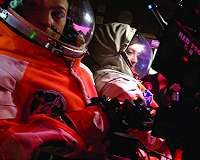
12 new Scientist-Astronaut Candidates have graduated at Embry-Riddle Aeronautical University in Daytona Beach, Florida, as part of PoSSUM Class 1701 through Project PoSSUM, a non-profit research program devoted to the study of Earth's upper atmosphere.
PoSSUM, an acronym for Polar Suborbital Science in the Upper Mesosphere, uses research aircraft, high-altitude balloons, and commercial suborbital spacecraft to study rare "space clouds" called noctilucent clouds. These elusive clouds can help scientists address critical questions about Earth's climate, but can only be studied in the upper atmosphere from polar latitudes during a small window of time in the summer. Project PoSSUM also conducts bioastronautics research, spacesuit-related technology development, and educational outreach missions.
The PoSSUM Scientist-Astronaut program, designed by former NASA astronaut instructors and hosted by Embry-Riddle gives its candidates the skills to effectively conduct research on commercial space vehicles as part of international research campaigns. The program is an intense training curriculum that covers atmospheric science, remote sensing, celestial mechanics, particle scattering, spaceflight physiology and PoSSUM instrument operations.
In addition, the students received comprehensive spacesuit training, mission simulation training, high-altitude and hypoxia awareness training, and aerospace physiology training in analog flight conditions. Contributing to PoSSUM Class 1701 were retired NASA astronauts Winston Scott and Nicole Stott, world-champion aerobatic pilot Patty Wagstaff, and Sci-Art Exchange Executive Director Dr. Jancy McPhee.
"The practical experience that Capt. Winston Scott, Patty Wagstaff, and Nicole Stott contributed greatly helped these PoSSUM students appreciate the complexities of spacesuit operations, the physiological strains of extreme aerospace environments, and the necessity of human components and artistic expression to communicate science," said PoSSUM Executive Director Dr. Jason Reimuller. "These are all essential elements of the PoSSUM mission."
The new PoSSUM graduates will become involved with existing research programs to study the upper atmosphere, evaluate IVA and EVA spacesuits, and participate in educational outreach and technology development programs in preparation for airborne and suborbital research missions. This summer, PoSSUM graduates will image noctilucent clouds from research aircraft in Northern Alberta with cameras designed for a high-altitude balloon campaign over Antarctica later this year.
This October the PoSSUM team will conduct the first visor-down, zero-G parabolic flight tests in Ottawa, Ontario as well as test the ability of the suit to perform a variety of post-landing contingency operations as part of the PoSSUM Bioastronautics Program.
NASA spacesuits over budget, tight on timeline: audit
The United States is in a hurry to send people to Mars by the 2030s, but a key question remains for these deep space explorers: what will they wear?
An audit report out Wednesday by the NASA Office of the Inspector General found that the US space agency has spent lots of money and time on developing new spacesuits, but has little to show for it.
"Despite spending nearly $200 million on N … read more
